Guy Leshno knew AutonomyAI’s website no longer matched the product it had become. He knew the positioning, pages, and visual direction the company needed. One problem: he had never worked with WordPress.
The familiar options both meant giving up momentum. Guy reported agency quotes in the several-thousand-dollar range and expected the redesign cycle to take months. Moving to an AI website builder such as Lovable or Base44 meant starting over on another platform.
Instead, Guy kept AutonomyAI’s existing WordPress and Elementor setup. Using Frontman, he changed the visual theme, redesigned almost every core marketing page, added use-case pages, worked on about five articles, and launched the new version himself. The broad relaunch took roughly two weeks of part-time work, including stakeholder review.
“Without Frontman, I would never have been able to accomplish this task by myself.”
— Guy Leshno, Marketing Lead at AutonomyAI
This was not AI replacing the marketer. Guy owned the positioning, content, visual judgment, stakeholder feedback, and final publication. Frontman gave him a way to turn those decisions into visible Elementor changes without waiting for an agency handoff or learning every part of the page builder first.
Disclosure: Frontman produced this case study about its own product, and the author, Danni Friedland, is a Frontman co-founder. Unless linked to a public source, project scope, duration, agency quotes, and prior WordPress experience are Guy’s account. This was not a controlled benchmark or conversion study.
From no WordPress experience to a launched redesign
| AutonomyAI redesign | |
|---|---|
| Site | autonomyai.io |
| Stack | WordPress and Elementor |
| Implementation owner | Guy Leshno, Marketing Lead |
| Previous WordPress experience | None |
| Scope | Homepage, visual theme, almost all core pages, use-case pages, and about five articles |
| Elapsed time | Roughly two weeks of part-time work, including stakeholder feedback |
| Alternative | WordPress agency or migration to a new AI website builder |
| Agency quotes received | Several thousand dollars |
The contrast matters: this was not a one-page experiment or a copy-only refresh. Guy took ownership of a broad marketing-site relaunch while the existing CMS, plugins, and publishing workflow stayed in place.
The site had fallen behind the product
AutonomyAI builds Fei Studio, an AI delivery system that helps product managers and designers turn product decisions into code that engineers can review and merge. As the company sharpened that positioning, its marketing site needed more than new hero copy.
The homepage had to explain a different product story. New role and use-case pages had to support it. Existing pages and articles had to align with the same message and visual direction.
The work was already clear in Guy’s head. The missing piece was a practical way to make it real on the site.
The choice: hire an agency or start over elsewhere
The conventional option was to hire a WordPress agency. Guy reported that AutonomyAI received quotes in the several-thousand-dollar range. He expected the redesign, feedback cycle, and launch to take months.
The team also considered moving the site to Lovable, Base44, or another AI-first builder.
WordPress already supplied the content management system (CMS), plugins, and publishing workflow. Rebuilding elsewhere meant migrating that setup and depending on another provider. Once Frontman gave Guy a visual AI editor inside WordPress, moving no longer offered AutonomyAI a clear advantage.
Frontman created a third option: keep the stack, keep control of the work, and shorten the distance between a marketing decision and a live page.
A homepage that finally matched the product
The homepage carried the largest part of the repositioning. It had to make the new product promise clear before a visitor reached the details.
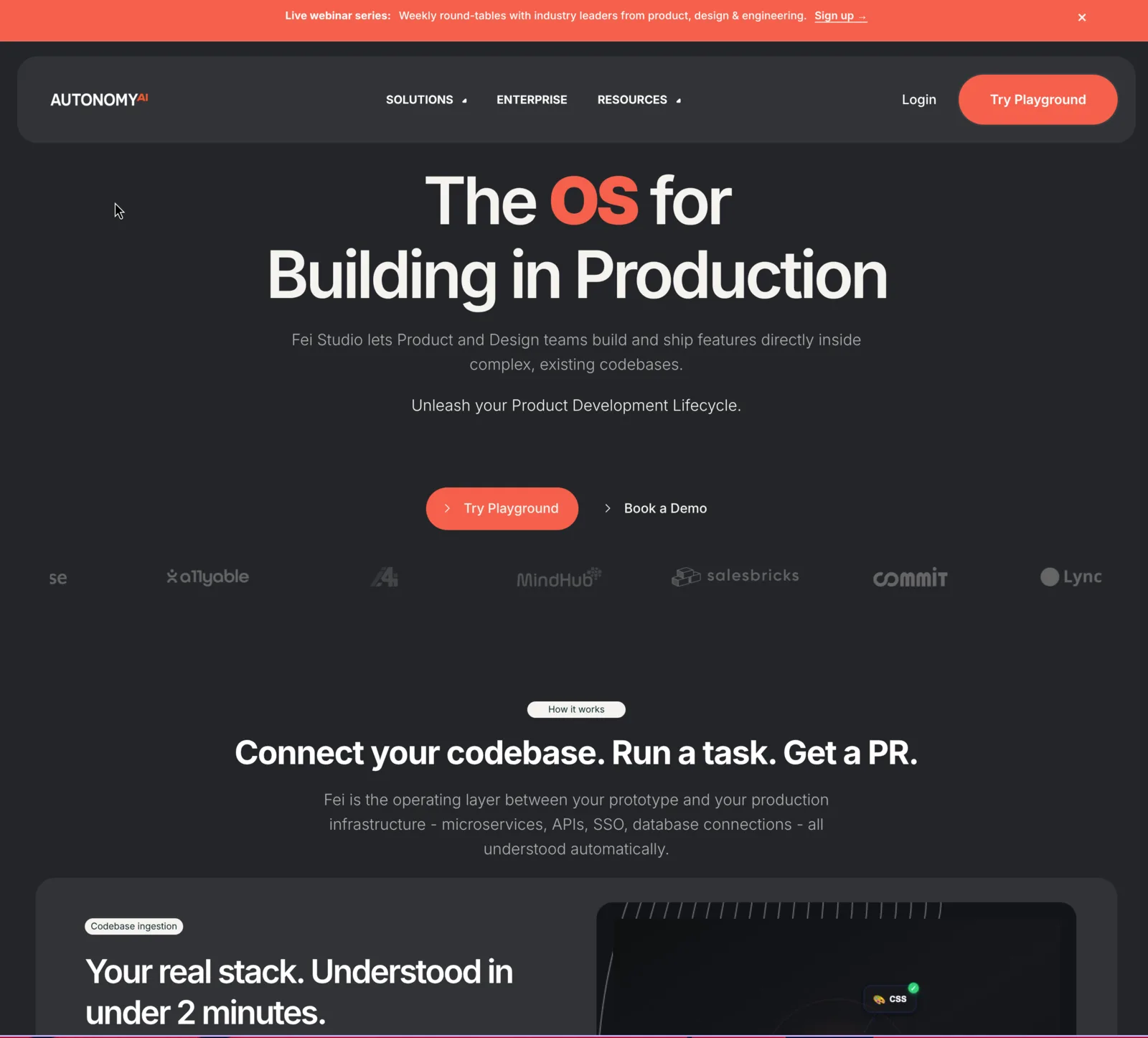
Before: a dark homepage led with “The OS for Building in Production.” This case-study artifact does not include its original capture date.
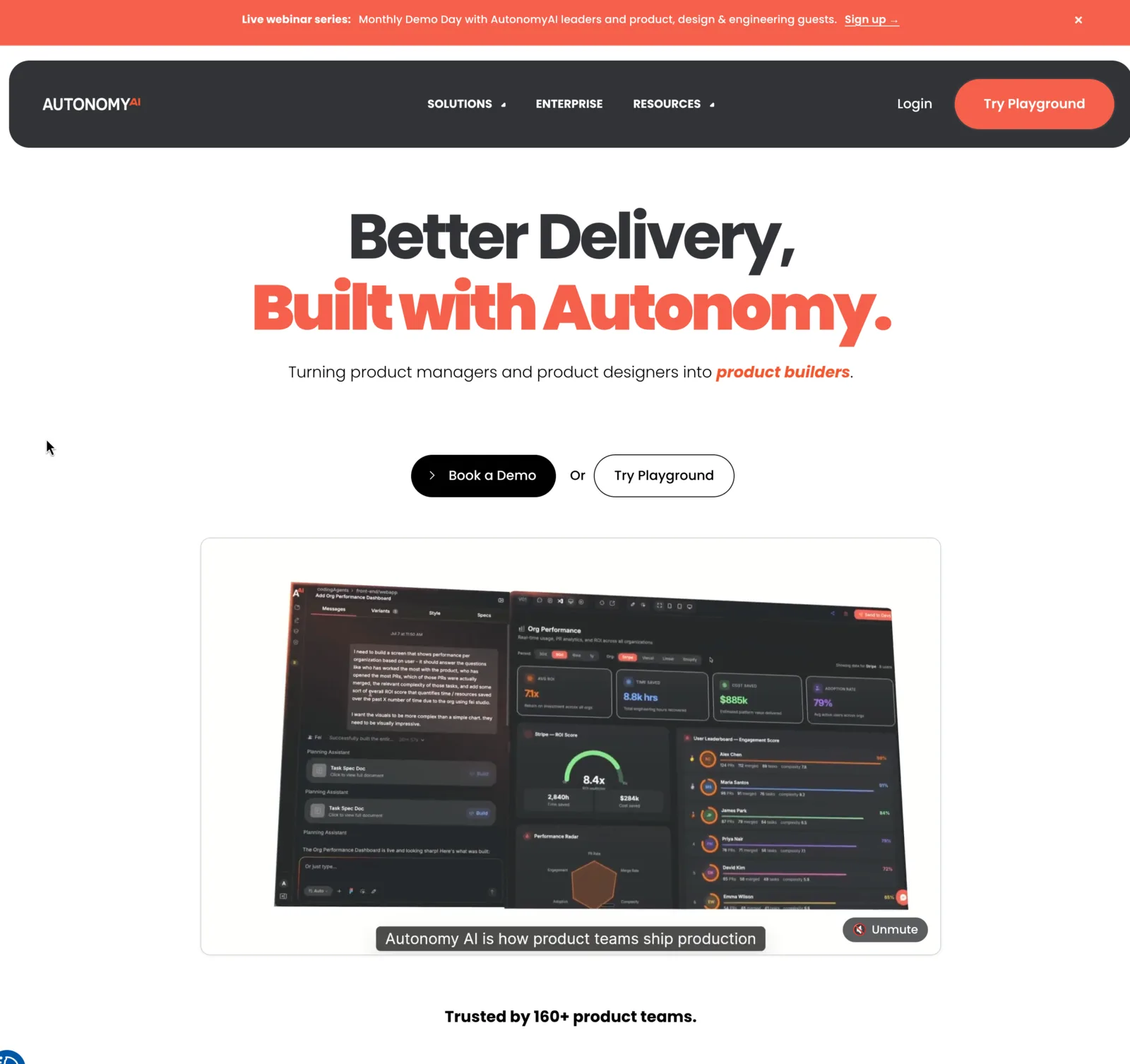
After: a brighter homepage leads with “Better Delivery, Built with Autonomy” and names product managers and designers as product builders. Frontman checked this capture against the live site on August 27, 2026.
The redesigned hero makes the audience and outcome more immediate. It moves product proof higher on the page, puts “Book a Demo” and “Try Playground” side by side, and replaces the dark visual field with a brighter presentation while retaining AutonomyAI’s coral brand color. The same direction then carried into core pages, new use-case pages, and articles.
From visible problem to published change
Guy’s workflow stayed close to the visible site:
- Install and activate the Frontman WordPress plugin.
- Open the site through Frontman’s live preview.
- Select the page element or section that needs to change.
- Describe the intended result in plain language.
- Review the visible result and request another pass when needed.
- Share the updated page with stakeholders and incorporate feedback.
- Publish the accepted version.
That loop kept Guy close to the work he understood best. He could point at the visible problem, explain the desired outcome, and judge the result in context. Frontman handled supported WordPress and Elementor operations underneath.
Guy did not have to translate every marketing decision into page-builder steps or wait for someone else to do it. He could move from idea to visible result, bring stakeholders into the review, and keep iterating while the context was still fresh.
Some changes needed several prompt iterations. Stakeholders reviewed the messaging and design, and Guy decided when each result was ready to publish.
This case study does not expose Guy’s exact prompts or a task-by-task change log. For a separately documented example, watch one complete staging-safe WordPress task from request through reviewed result.
Two weeks of momentum, backed by production history
This was sustained production work, not a polished one-prompt demo. Across 10 active days, Frontman’s task history records 852 Elementor mutation calls and 282 screenshot calls as Guy built, reviewed, and refined the site. The wider record includes 45 task threads, 345 user interactions, and 3,801 tool calls.
With Guy’s authorization, Frontman queried aggregate event metadata for his account during the confirmed redesign window. The query ran in a read-only production database transaction. It did not export prompts, task titles, page URLs, identifiers, tool arguments, tool results, or other customer content.
| Task-history measure | Recorded result |
|---|---|
| Redesign activity window | July 3 at 09:02 UTC through July 17 at 16:06 UTC |
| Active days | 10 days within a 15-calendar-day window |
| Task threads | 45 created; 44 contained recorded activity |
| User interactions | 345, all with an AutonomyAI page in the current-page context |
| Threads with multiple user interactions | 34 of 44 active threads, or 77% |
| Selected-element annotations | 74 |
| Total tool calls | 3,801 |
| Elementor mutation calls | 852 add, update, remove, move, or generate operations |
| Elementor inspection calls | 484 element, page-structure, or page-list operations |
| Visual verification | 282 screenshot calls and 15 device-mode changes |
| Other implementation calls | 51 custom-CSS updates and 19 media uploads |
The history also records the messy part of real work: 99 tool results marked as errors, 31 agent-error events, and 21 automatic retry events. These are not 99 failed tasks. One request can trigger many tool calls and recover within the same thread. The important point is that Guy kept reviewing and iterating rather than depending on one perfect prompt.
Using user interactions to define sessions, with a new session after more than 30 minutes of inactivity, produced 40 sessions and 24.0 observed session hours. Nine single-interaction sessions contribute zero duration. That makes 24.0 hours a conservative activity estimate, not a payroll record or a complete measure of Guy’s work.
What can be verified independently
The customer account, live site, public review, and production metadata do not all prove the same things. This table keeps those evidence boundaries visible.
| Claim | Evidence status |
|---|---|
| Guy Leshno is AutonomyAI’s Marketing Lead | Confirmed on AutonomyAI’s team page |
| AutonomyAI uses WordPress and the after-state design is live | Confirmed on the current AutonomyAI site on August 27, 2026 |
| Frontman provides a visual WordPress workflow and Elementor-aware tools | Confirmed by the WordPress Plugin Directory |
| Public account of selection, prompting, and time savings | A WordPress.org review under the username leshno describes selecting elements, requesting changes, and saving hours |
| Two-week duration, agency quotes, page scope, and prior WordPress experience | Customer-reported in this case study; no public project log or quote document was reviewed |
The WordPress.org review supports the editing pattern and reports that most requested changes completed quickly. It does not verify the agency comparison or exact number of pages. Production metadata supports the reported two-week activity window, but it does not measure business outcomes.
What AutonomyAI gained
AutonomyAI gained a redesigned site without abandoning its CMS, migrating its content, or entering the agency process Guy expected to take months. Guy went from no WordPress experience to launching a broad Elementor redesign himself in roughly two weeks of part-time work.
Just as important, ownership stayed with the person responsible for the message. Guy could make a decision, see it on the real page, gather stakeholder feedback, and request another pass without rebuilding context at every handoff.
Frontman did not make the strategic decisions. It made those decisions easier for Guy to execute. That is the practical result: less distance between knowing what the site should become and being able to ship it.
What this result does not prove
This was one customer project, not a controlled comparison between Frontman, an agency, and an AI website builder. One result cannot promise the same timeline for every theme or plugin setup. Frontman did not review redacted agency proposals, measure an agency implementation, or calculate cost savings from recorded work hours.
The project also did not measure conversion lift, search traffic, accessibility, page speed, or post-launch defect rate. The evidence supports a narrower conclusion: Guy reported completing a broad Elementor redesign himself, the redesigned site is live, and public product documentation supports the workflow he described.
Theme, plugin, hosting, and custom-Elementor setups vary. A result on AutonomyAI’s site does not establish the same timeline for another WordPress stack.
Start with one Elementor section
You do not need to begin with a full-site redesign. Pick one Elementor section whose message or layout is holding the page back. Select it, describe what should change, and review the result on the actual page. Keep it, refine it, or reject it.
That small loop is the same one Guy repeated across AutonomyAI’s site. To try it, install Frontman - Agentic AI Editor from the WordPress Plugin Directory on a staging copy, a private test version of your site, then open Frontman from the WordPress admin menu.
Frontman is beta software. Keep backups and review every change before production. You will need WordPress administrator access, a Frontman sign-in, and a supported AI model provider. Read the WordPress security boundaries before connecting a production site.
Need setup details? Read the WordPress integration guide.